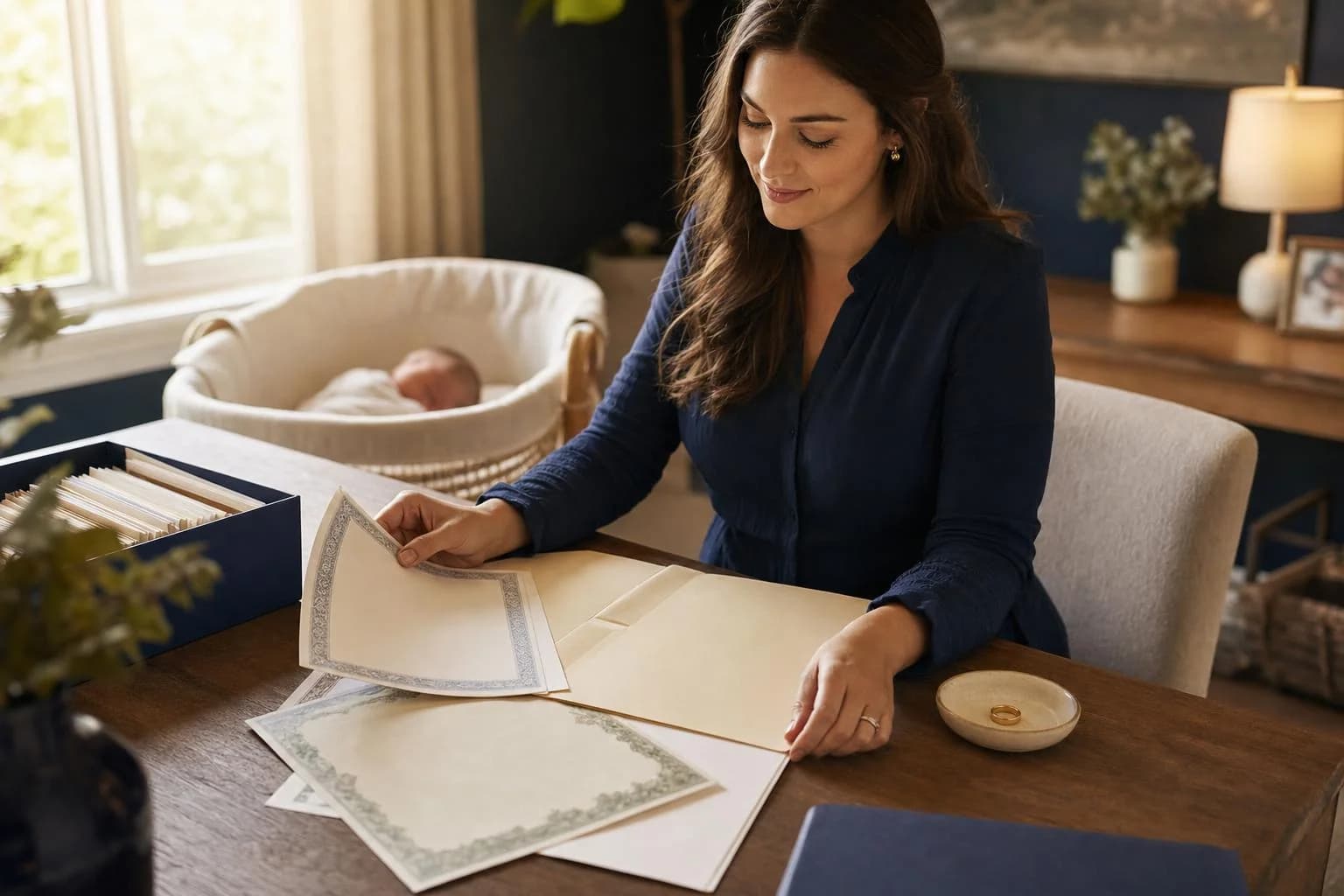
If you plan to add a spouse or child to your health plan during this year's Open Season, you will need to show they are eligible before the enrollment is finalized. The documents to add a family member to FEHB are things most families already own, such as a marriage certificate, a birth certificate, or adoption papers. Gathering them now, before Open Season opens on November 9, is the simplest way to keep your family's 2027 coverage on track.
This is a new requirement for Open Season, and it applies to both the Federal Employees Health Benefits (FEHB) Program and the Postal Service Health Benefits (PSHB) Program. Here is what changed, who it affects, and exactly what to have ready.
What changed for Open Season this year
The FEHB Protection Act of 2025, part of Public Law 119-21 signed July 4, 2025, directs the Office of Personnel Management (OPM) to strengthen family member eligibility verification. In the past, agencies verified family members mainly when you first enrolled or had a qualifying life event, such as a marriage or birth. Open Season additions were often only spot-checked.
That has now changed. According to OPM's Benefits Administration Letter 26-202, beginning with Open Season for plan year 2027, employing offices must verify the eligibility of every newly added family member before the enrollment can be finalized. OPM's Open Season highlights put it plainly: anyone adding a new family member to an FEHB or PSHB plan during Open Season must submit supporting documentation.
A related change took effect earlier. Since July 4, 2026, every qualifying life event that adds a family member must also be reviewed and verified.
Who this affects
The rule applies when you add someone. It covers employees and annuitants who:
- Switch from Self Only to Self Plus One or Self and Family to cover a spouse or child.
- Add a new family member to an existing Self and Family enrollment.
According to OPM's guidance, if a family member was already verified during the plan year, for example after a qualifying life event, you will not need to send documents for that person again.
Who counts as an eligible family member
Before gathering paperwork, confirm the person is eligible at all. OPM lists these eligible family members:
- Your spouse.
- Children under age 26, including adopted children, stepchildren, and foster children.
- A disabled child age 26 or older who is incapable of self-support because of a physical or mental disability that existed before their 26th birthday.
Some relatives are not eligible even if they live with you and depend on you. OPM gives examples: your parents, a former spouse, and a domestic partner. A grandchild is not eligible unless the child qualifies as a foster child.
FEHB documents you need to add a family member
OPM's FEHB Handbook lists the documents that can establish eligibility. You can remove personal financial information and Social Security numbers from copies before you submit them. Documents not in English must come with a certified or notarized translation.
Spouse
- Married less than 12 months: a copy of your government-issued marriage certificate.
- Married 12 months or more: the marriage certificate plus one of the following sets: the front page of your most recent federal or state tax return, or proof of common residency (such as a utility bill or auto registration) together with proof of financial interdependency (such as a shared bank statement or an insurance policy).
- Common law marriage: a court order recognizing the marriage, or a signed declaration with specific details about the marriage, along with additional supporting documents. This is only an option if the marriage was established in a state that recognizes common law marriage.
Child under age 26
Any one of these documents listing both the child and you: a government-issued birth certificate, a certificate of live birth, the front page of your most recent federal or state tax return, a Consular Report of Birth Abroad, an official paternity test, a voluntary affidavit of paternity, or a court or administrative order such as a National Medical Support Notice.
Adopted child
Any one of these listing the child and you: a final adoption certificate or decree, an authorized letter from a placement agency for the purpose of adoption, the front page of your most recent tax return with the child's name, or a court or administrative order.
Stepchild
A birth certificate or final adoption decree listing your current spouse as the parent, the front page of your most recent tax return with the child's name, or a court or administrative order. You must also verify your spouse's eligibility, even if your spouse is not joining your plan.
Foster child
All of the following: a signed certification of foster child status, a birth certificate or other document showing the child's date of birth, and proof of regular and substantial support. Support can be shown with items like tax returns listing the child as a dependent, canceled checks or receipts for payments on the child's behalf, or evidence of eligibility as a dependent under other programs. Include a court order naming you or your spouse as legal guardian, if you have one.
Disabled child age 26 or older
A medical certificate stating the child is incapable of self-support because of a physical or mental disability that existed before age 26 and is expected to last more than one year.
The full table is on OPM's family members reference page.
What happens after you submit
OPM asks agencies to make every effort to verify new family members within 30 days of receiving acceptable documents. If verification happens after coverage has already started and the person is found ineligible, the employing office will remove that individual under FEHB regulations.
If your documents are judged insufficient, your employing office must send you a written notice explaining why. That notice must also explain your right to ask for reconsideration. According to OPM's handbook, you have 60 calendar days from the date of that letter to request reconsideration in writing, and the office must issue its final decision within 30 calendar days of receiving your request. If the decision is reversed, coverage is restored back to the date it would have started.
If you change your Open Season election more than once, OPM says the office verifies eligibility on your final election. If a family member was already verified on an earlier election in the same Open Season, you do not need to resubmit.
A word about accuracy
Including someone who is not eligible is a serious matter. The handbook reminds enrollees that intentionally false statements can be punished by a fine of up to $10,000, up to five years in prison, or both. If you are unsure whether someone qualifies, ask your benefits officer before you enroll them.
A simple plan to get ahead
You do not need to wait for Open Season to start. A little preparation this week can save weeks of back-and-forth later.
- 01Decide now whether you will add anyone for 2027.
- 02Find the original documents and make clean copies or scans.
- 03Redact Social Security numbers and financial account numbers.
- 04Ask your benefits officer, or the office that handles your retirement benefits if you are an annuitant, how to submit documents. Each agency uses its own systems.
- 05Submit your election and documents together, early in the November 9 to December 14 window.
- 06Keep copies and confirmation numbers, and check your first 2027 statement.
Adding a family member also changes your premium, so it is worth looking at the new enrollment type's 2027 cost before you finalize. Our budget guide can help you see how the change fits your monthly plan.
How this fits your bigger picture
Family coverage decisions ripple into retirement too. Covering a spouse in retirement and planning survivor benefits are connected questions. The Federal Retirement Blueprint covers FEHB alongside your pension, TSP, and Social Security, and the 10-step roadmap shows where health coverage fits in your overall plan. You can find more guides in our federal benefits articles.
For OPM's own questions and answers on this rule, see the Family Member Eligibility Verification page.
Frequently asked questions
Do I need documents to add my spouse during Open Season?
Yes. Beginning with Open Season for plan year 2027, OPM requires documentation for every family member added during Open Season. For a spouse, that starts with a government-issued marriage certificate, plus additional proof if you have been married 12 months or more.
I already cover my family. Do I need to send anything?
The new requirement applies to family members being added. If you are not adding anyone, OPM's guidance focuses on new additions. If you are unsure whether your enrollment counts as an addition, such as when you change plans, ask your benefits officer.
Can I black out my Social Security number on the documents?
Yes. OPM states that enrollees may remove personal financial information and Social Security numbers before submitting documents.
What if my documents are rejected?
Your employing office must send a written notice explaining why. You can request reconsideration in writing within 60 calendar days of that letter, and the office must give a final decision within 30 calendar days of receiving your request.
Does this apply to Postal Service employees and retirees?
Yes. The requirement covers the FEHB Program, which includes the Postal Service Health Benefits Program.
When is Open Season?
Open Season runs from November 9 through December 14, 2026, for coverage in plan year 2027.